
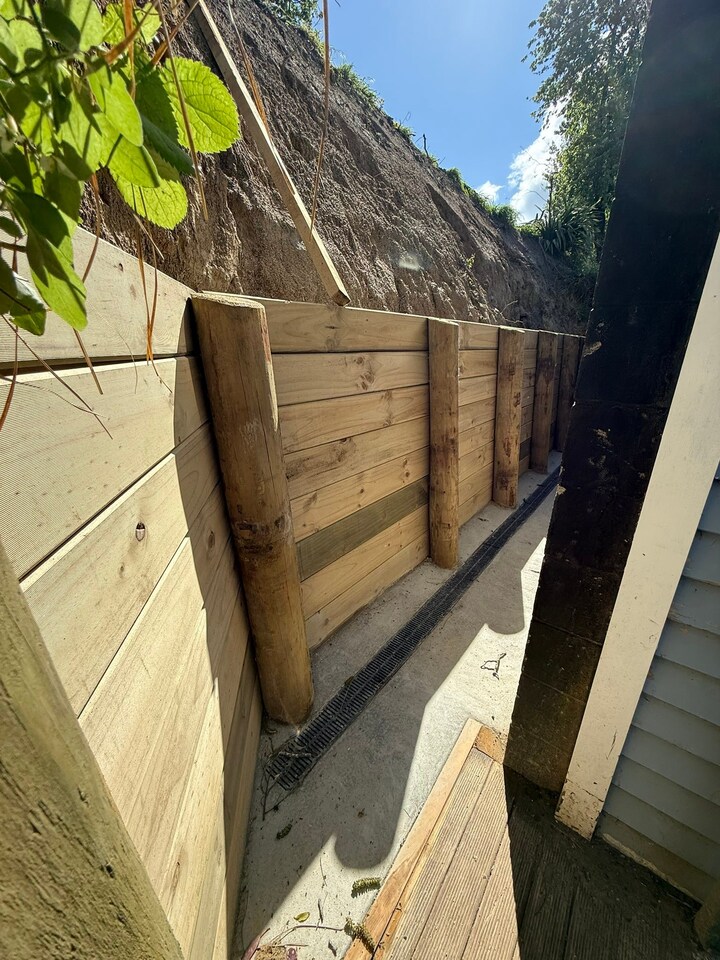
Replacing a failed retaining wall on a steep Lyttelton section
We recently completed a retaining-wall project behind a home in Lyttelton. The old wall had failed and the bank was slipping toward the house, while the steep ground above was difficult for the owners to use.
Our job was not simply to replace the visible timber. We needed to establish safe access, remove unstable material, construct the new retaining system and reshape the area so the finished result protected the house and made better use of the section.
Restricted access changed the way we approached the job
Like many Lyttelton properties, this site had very limited access. Machinery, materials and spoil could not simply move straight in from the road. We planned the job around the available route and selected equipment that could work safely within the confined space.
Careful sequencing was important. Excavating too much at once would have created unnecessary instability and made material handling harder. We worked progressively, maintaining access while the wall, drainage and backfill were installed.
What the retaining-wall work involved
- removing unstable soil and the failed wall components;
- benching and preparing the bank for construction;
- augering holes and installing new retaining poles;
- constructing the timber wall to the required lines and levels;
- installing drainage and free-draining material behind the wall;
- controlled backfilling and compaction; and
- reshaping the upper area for landscaping and outdoor use.
Turning steep ground into useful space
The completed wall removed the slip risk immediately behind the home and created a much more practical area above. Ground that had previously been too steep to use could now become an outdoor entertaining and landscaping space.
This is one of the main benefits of a well-planned retaining project. A wall can provide stability, but it can also improve access, create level ground and make a difficult section work better for the property owner.
Drainage is critical behind retaining walls
Water pressure is a common contributor to retaining-wall movement and failure. We allow for drainage behind the wall using suitable free-draining aggregate, filter fabric and subsoil drainage where required. The surrounding ground also needs to be shaped so surface water is directed appropriately.
Every site is different, so the wall design and construction method must reflect the height, loads, soil conditions, water and nearby structures. Where engineering or consent is required, we work to the approved documentation.
Retaining-wall construction across Lyttelton and Christchurch
We build and replace retaining walls throughout Lyttelton, Governors Bay, Diamond Harbour, Cashmere and wider Christchurch. Because we also carry out excavation, cartage, drainage and site preparation, we can manage the earthworks surrounding the wall rather than leaving separate contractors to coordinate each stage.
If a retaining wall is leaning, cracking, rotting or allowing soil to move, it is worth having it assessed before the damage grows. Call Trent on 027 858 0556 to discuss retaining-wall replacement or hillside earthworks in Lyttelton and across Christchurch.
Posted: Friday 21 November 2025